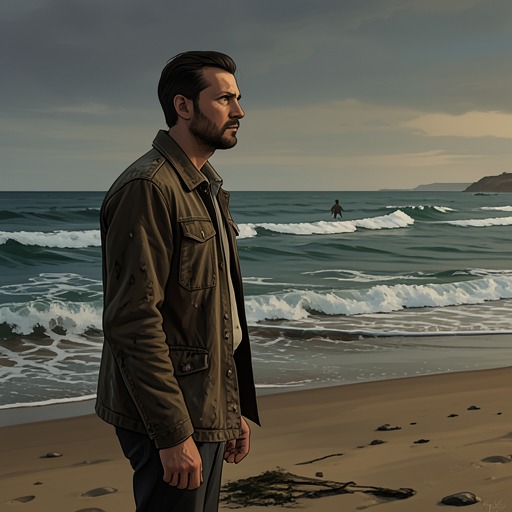
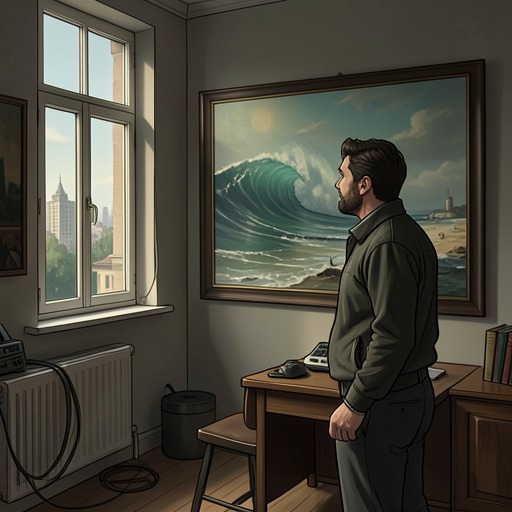
The seventh man returns to his hometown beach
Blind Willow, Sleeping WomanThe seventh man’s return to the beach where K was swept away marks a decisive turn in his long struggle with guilt and fear. More than forty years after fleeing his hometown, he revisits the shore and reinterprets the loss that had shaped his life: he can no longer be certain that K looked at him with accusation, and he finds himself able to enter the water without fear. The return does not restore the past, but it brings an end to the recurring nightmares and allows him to begin again.
The return becomes possible
For decades, the seventh man had stayed away from his hometown and from the sea. The beach was where K had been carried away during a typhoon, and the man feared that the drowning he had imagined in recurring nightmares might happen in reality. He avoided swimming pools, deep rivers and lakes, boats, and even overseas travel by plane. The fear persisted despite these precautions, and the memory of K’s cold hand remained fixed in his mind.
The change began after the death of his father. His brother sold the old family home and sent him a carton of childhood belongings found in a storage shed. Among them was a bundle of watercolors K had painted and given him. At first, the pictures seemed to threaten the fragile distance he had kept from the past; he wrapped them up again, intending to throw them away, but could not bring himself to do so. Instead, he began to look at them at his desk after work, studying one picture at a time.
The watercolors showed familiar landscapes: the ocean, beach, pine woods, and town. Their clarity brought back the places and experiences the seventh man had shut out, and with them a sense of the way he and K had once seen the world. Looking at K’s work repeatedly did not erase the loss, but it gave the man a way to revisit the past that was different from the nightmares.
Reconsidering K’s last expression
One evening, while studying a watercolor, the seventh man questioned the interpretation that had haunted him. He had long believed that K’s grin as the wave took him carried hatred or resentment, perhaps an attempt to draw his friend into the water. Now he considered other possibilities: K may already have lost consciousness, the expression may have been caused by the angle or the light, or K may have been giving him a gentle farewell. What he had read as hatred, he realized, could instead have reflected the terror that had overwhelmed him.
This reconsideration changes the meaning of the memory without changing what happened. The seventh man had previously believed he might have saved K, and he continued to remember that he had been overcome by fear and had left his friend behind. K’s parents never blamed him; they searched the beach and withdrew into grief, while the man’s own parents avoided mentioning the incident. That silence did not free him from guilt. The watercolors instead let him look again at K’s face and life without treating his own terrified perception as certain evidence of K’s feelings.
After sitting with the picture through the night, the seventh man became convinced that he had to go back. He took a few things, called his company to say he would be absent, and boarded a train for his old hometown. The decision followed a slow change in how he understood the past, rather than a sudden recovery that had already taken place.
The changed hometown and familiar shore
The place he returned to was no longer the quiet seaside town he remembered. An industrial city had grown nearby during the rapid development of the 1960s. The station’s small gift shop had become a mall, and the town’s only movie theater had been turned into a supermarket. His family home had been demolished, and the trees in its yard cut down; K’s former house had given way to a concrete parking lot. The man did not claim the town as his own: it had ceased to belong to him long before his return.
The shore, by contrast, remained recognizable. He climbed the breakwater and saw the long beach, the waves, and people walking at the water’s edge. Sitting on the sand with his bag beside him, he found it difficult to connect the peaceful scene with the typhoon and the wave that had taken K. The contrast made the catastrophe seem almost unreal, as though it belonged to an account he had imagined rather than to his own past.
Then the darkness he had carried inside him disappeared. He stood and walked into the surf without removing his shoes or rolling up his trousers. The waves reached his ankles and soaked his shoes and cuffs. Their return to shore no longer appeared only as a threat: in that moment, he experienced them as almost reconciliatory. He had found his way back, not to the unchanged town or to K, but to a present in which the sea no longer held the same power over him.
Recovery without erasing the past
As he looked up at the sky, he remembered searching for the eye of the typhoon as a boy. The memory brought past and present together so forcefully that he lost his balance and fell into the waves. His heart beat in his throat, and he could not feel his arms and legs for a time. But he was not afraid. The physical disorientation did not return him to the earlier terror; he understood that those days were over.
After the return, the nightmares stopped, and he no longer woke screaming. He knew that beginning life again might come too late, and that he might not have much time left. Even so, he was grateful to have reached a form of recovery rather than live out his days still frightened in the dark. His account therefore presents the visit not as a recovery of the years lost to fear, but as a belated release from its hold.
The event’s significance rests on the difference between forgetting and reconsidering. K’s watercolors recover childhood memories, while the return to the beach lets the seventh man encounter the place associated with his guilt without abandoning himself to that guilt. He does not undo his failure to try to save K, nor does he learn with certainty what K’s final expression meant. He gains something more limited and more consequential: the ability to recognize that terror had shaped his memory, and to live without treating the sea as an inevitable repetition of the past.